A growth mindset is easier for a young child to understand through doing than through explanation. A tower that falls, a paper bridge that bends or a drawing that improves on the second attempt creates a concrete experience of learning.
The activities below are deliberately simple. Most use things already at home and can be stopped after ten minutes. The aim is not to make children persist forever; it is to practise trying, adapting and noticing progress.
If you are building these habits at home, explore our Growth Mindset hub and Quest & Bloom books for more practical ideas.
1. Building and engineering challenges
Construction play creates immediate feedback. If a bridge collapses, the child can see what happened and alter the design. Keep the challenge open enough that there is more than one possible solution.
Ask questions rather than directing the build. “What could make the bottom stronger?” is more useful than placing the block yourself.
- Build the tallest tower from 20 blocks.
- Make a paper bridge that holds five coins.
- Build a ramp that makes a toy car travel farther.
2. Drawing and making activities
Creative work is ideal for comparing attempts without a right-or-wrong answer. Ask a child to draw something difficult, study a reference together, then make a second version.
Talk about what changed between attempts. Avoid turning the second picture into a test of whether they improved enough.
- Draw the same animal twice after noticing three details.
- Make a paper aeroplane, test it, then change one fold.
- Build a creature from recycled boxes and redesign a weak part.
3. Puzzle-style challenges
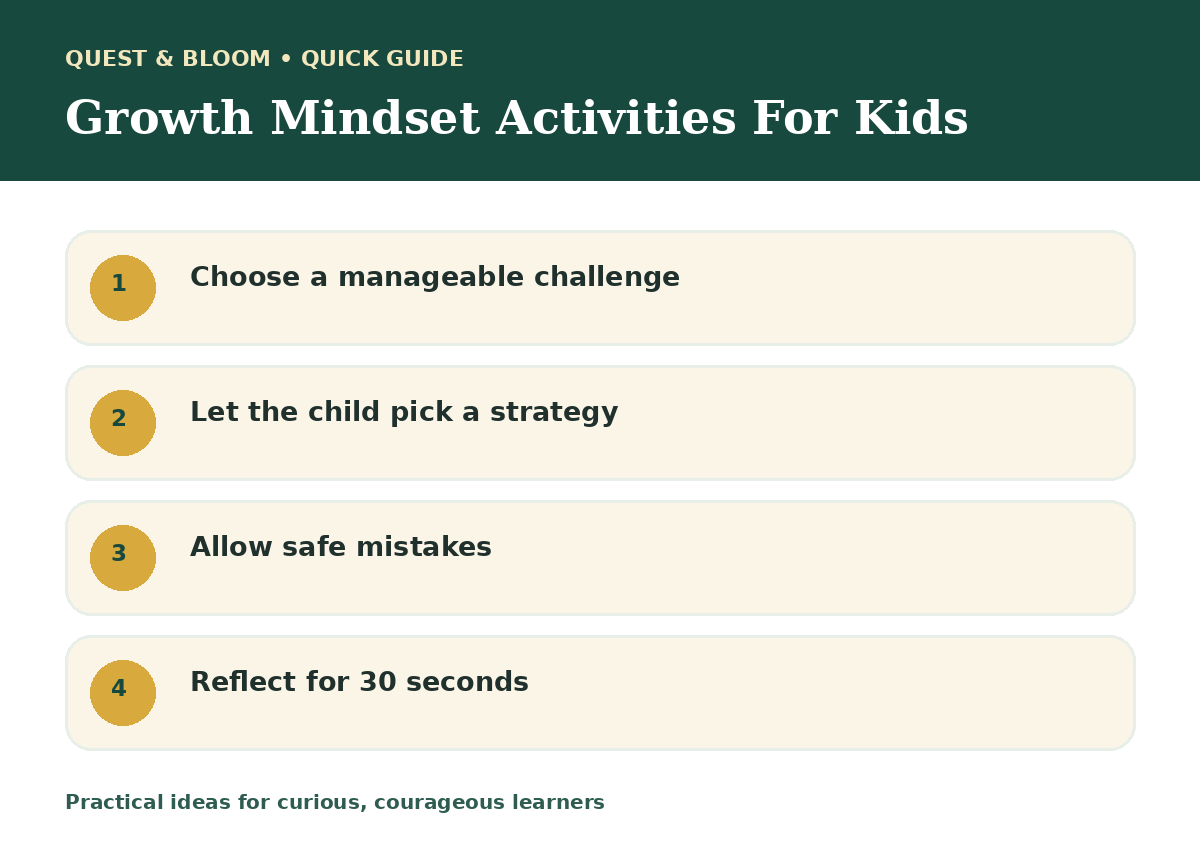
Choose puzzles that are just beyond effortless. If frustration rises sharply, offer a hint or remove part of the complexity. Productive challenge should feel difficult but possible.
Afterwards ask which strategy helped: sorting colours, starting with edges, rotating pieces or taking a break.
- Jigsaw with a few more pieces than usual.
- Simple maze drawn on paper.
- Hide an object and give clue cards in the wrong order to rearrange.
4. Family beginner activities
Choose an activity nobody in the family is already good at. Adults should take part so children can watch them make mistakes and recover.
This removes the adult-as-expert dynamic and makes learning visible.
- Try a new dance step.
- Learn a simple magic trick.
- Make an origami shape from instructions.
5. Reflection games
Reflection turns an activity into a learning experience without needing a lecture. Keep it brief and specific.
One good question is enough. The child should not feel interrogated after every game.
- What was the trickiest part?
- What helped most?
- What would you change if you did it again?
Related Quest & Bloom guides
- Growth Mindset for Kids: 12 Practical Ways to Help Children Learn, Persist and Grow
- 12 Problem-Solving Activities for Kids That Need Almost No Preparation
- Perseverance Activities for Kids: Fun Ways to Practise Not Giving Up
- A 7-Day Family Growth Mindset Challenge for Children Ages 4–8
Frequently asked questions
How long should a growth mindset activity last?
For ages 4–8, ten to twenty minutes is often plenty. Stop while the challenge is still constructive rather than pushing through escalating frustration.
Do I need special growth mindset worksheets?
No. Everyday building, drawing, puzzles, games and practical tasks can provide richer practice because the child receives real feedback.
Should I let my child fail?
Allow safe, manageable mistakes, but stay available. The goal is supported learning, not leaving a child stuck with something they cannot yet do.
Sources and further reading
- American Psychological Association — principles for families and learning
- Stanford — Carol Dweck on process praise, challenge and perseverance
- American Academy of Pediatrics — The Power of Play
Keep exploring: Our personalised children’s adventures are designed around curiosity, courage, problem-solving and learning through the story itself.
This article is general educational information for parents and carers. Children develop at different rates; seek appropriate professional advice for individual developmental, educational or health concerns.