Young children meet dozens of small challenges every day: a puzzle that will not fit, a word they cannot read, a picture that looks wrong, a game they lose or a model that collapses. Those moments are where a growth mindset becomes useful.
For children aged 4–8, the idea is best taught through ordinary life rather than lectures. A parent who calmly treats mistakes as information and notices useful strategies gives a child repeated evidence that being stuck is not the same thing as being incapable.
If you are building these habits at home, explore our Growth Mindset hub and Quest & Bloom books for more practical ideas.
1. Make “yet” useful, not automatic
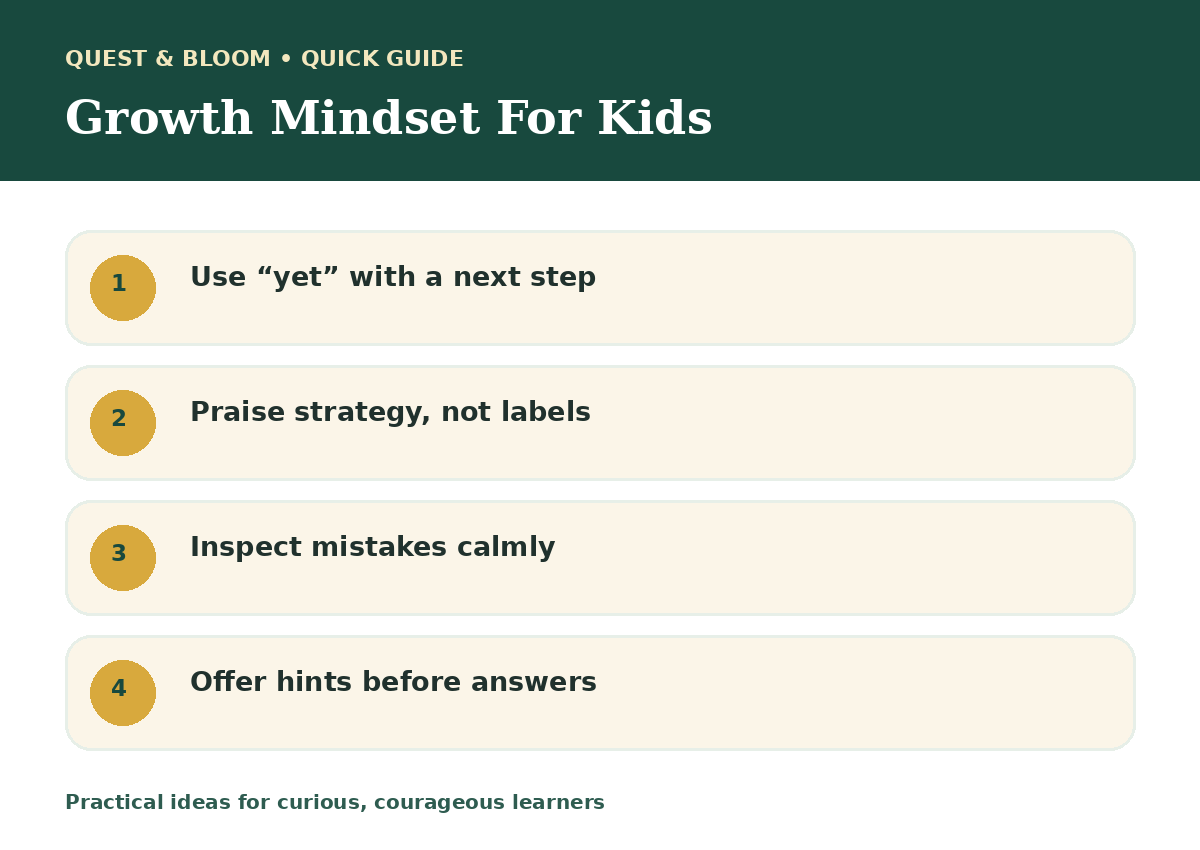
Adding the word “yet” can turn a final-sounding statement into a temporary one: “I can’t tie my laces yet.” The important part is what comes next. Pair “yet” with a real next step: watch one loop, practise the first knot, or ask for a hint.
If “yet” is used every time a child complains it can become a slogan they tune out. Use it when it genuinely opens a path forward.
- “I can’t do it.” → “You can’t do it yet. Which part should we practise?”
- “I’m bad at this.” → “Which bit feels hardest right now?”
2. Praise the process a child can repeat
Labels such as “clever” and “talented” feel positive, but they do not tell a child what helped. Specific feedback points to actions they can use again.
Notice strategy, focus, courage, asking for help, checking work and changing approach. That turns praise into information rather than applause.
- “You kept trying different pieces until you found the fit.”
- “You slowed down and checked the tricky word.”
- “You asked for a clue instead of giving up.”
3. Treat mistakes as clues
A wrong answer is not a verdict on ability. Help children inspect mistakes without drama. Ask where things started to go wrong, what part worked and what one thing they will change next time.
Do not force a celebration of every mistake. A calm, matter-of-fact response is often more believable: “That didn’t work. Good — now we know one thing to change.”
- What did the mistake show us?
- Which part was right?
- What will you change on the next attempt?
4. Help without taking over
Children need support, but rescuing too quickly removes the part where they learn to manage difficulty. A useful middle ground is: “Would you like a hint, or another minute to try?”
That question preserves agency while making help available. If the task is genuinely beyond the child, scaffold it by doing the first step together and handing the next step back.
- Offer a clue rather than the answer.
- Shrink the task to one manageable step.
- Give two choices about how to continue.
5. Make progress visible
Young children can forget how hard something used to be. Keep an early drawing, writing sample or short video and compare it with a later attempt. The aim is not performance tracking; it is evidence of change.
Say: “Look what is different now,” rather than “Look how good you are.” That keeps attention on learning.
- Save first attempts occasionally.
- Compare with the child’s own past work, not another child.
- Notice small changes in control, speed, confidence or strategy.
6. Model being a beginner
Let children see adults get things wrong, look at instructions, ask for help and try again. Narrate the useful part: “That method didn’t work, so I’m going to change it.”
This is powerful because children see that competence does not mean never struggling. It means knowing what to do when you struggle.
- Try a new recipe together.
- Learn a simple drawing or origami fold.
- Let the child teach you something they know.
Related Quest & Bloom guides
- Growth Mindset Activities for Kids: 15 Easy Ideas for Home
- 35 Growth Mindset Phrases for Kids That Parents Can Actually Use
- Fixed Mindset vs Growth Mindset for Kids: Simple Examples for Parents
- 9 Growth Mindset Mistakes Parents Make — and What to Do Instead
Frequently asked questions
What age can children learn a growth mindset?
You can model the underlying habits from the preschool years. Young children do not need the terminology; they benefit from hearing that skills can improve, mistakes can teach us something and help is part of learning.
Is praising effort always good?
No. Praise useful effort and strategy, not pointless repetition. If a method is not working, help the child change approach.
What if my child says “I can’t” constantly?
Start by checking whether the task is too hard, unclear or emotionally loaded. Then shrink the next step and offer support without taking over.
Sources and further reading
- American Psychological Association — principles for families and learning
- Stanford — Carol Dweck on process praise, challenge and perseverance
Keep exploring: Our personalised children’s adventures are designed around curiosity, courage, problem-solving and learning through the story itself.
This article is general educational information for parents and carers. Children develop at different rates; seek appropriate professional advice for individual developmental, educational or health concerns.