Board games and races are tiny laboratories for disappointment. A child can care deeply about winning, lose by one move, and discover that the world continues.
The goal is not to make children stop wanting to win. Competition can be exciting. The skill is learning that disappointment is allowed while shouting abuse, cheating or destroying the game is not.
If you are building these habits at home, explore our Growth Mindset hub and Quest & Bloom books for more practical ideas.
1. Set expectations before the game
Before starting, remind everyone of two rules: we play fairly and we finish safely. Do not deliver the lecture after emotions have already exploded.
Keep early games short so children have repeated opportunities to win and lose rather than one huge emotional event.
2. Model losing properly
When you lose, resist exaggerated fake cheerfulness. Say something believable: “Ah, I wanted that one! Good game.”
This shows that disappointment and respectful behaviour can exist at the same time.
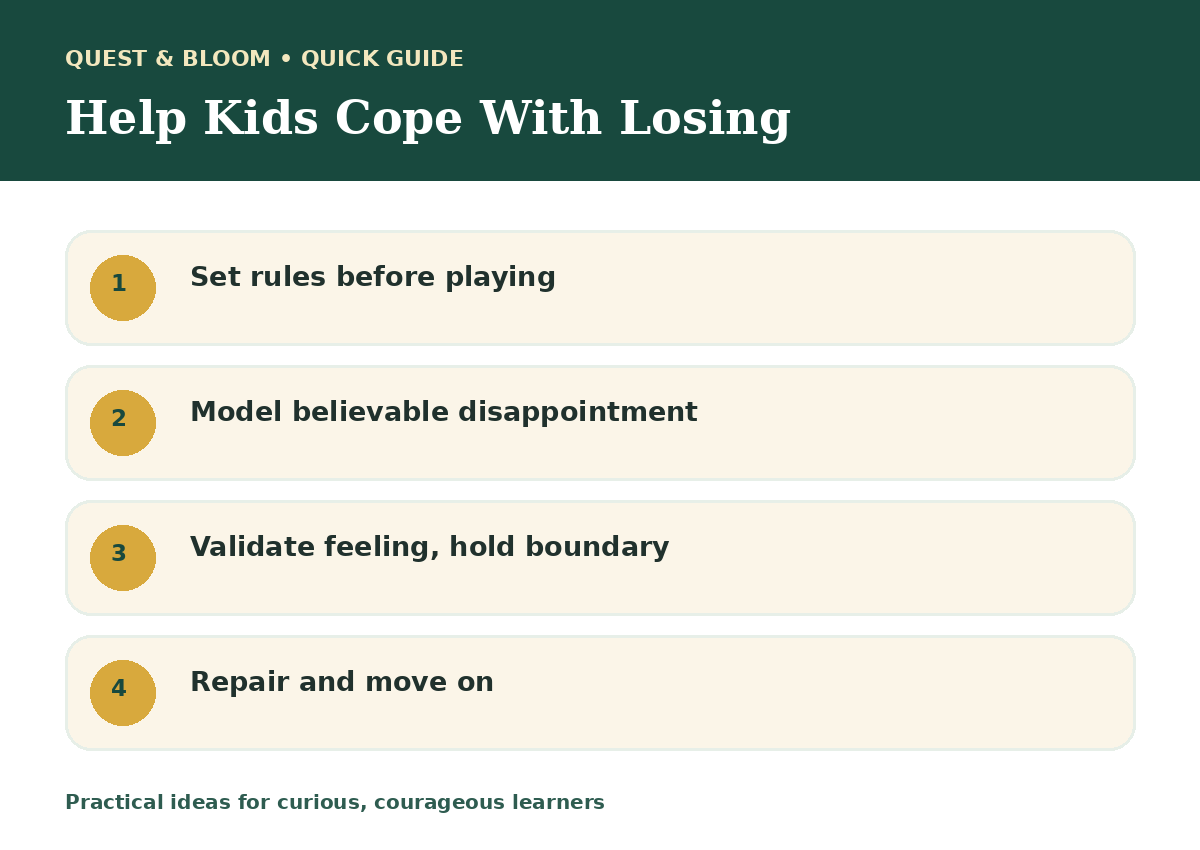
3. Validate the feeling, hold the boundary
“You really wanted to win” acknowledges the emotion. Follow with the boundary: “It’s okay to be upset. It’s not okay to throw the pieces.”
Separating feeling from behaviour helps children understand that emotions do not remove responsibility.
4. Avoid rescuing with fake wins
Occasionally adjusting a game for age is fine, but constantly letting a child win prevents practice with losing. Use games where luck plays a role so skill differences do not dominate every result.
Cooperative games can also teach shared problem-solving without eliminating competitive games completely.
5. Debrief later, briefly
Once calm, ask what helped them recover. If the child behaved badly, repair matters: pick up pieces, apologise, reset.
Then move on. Losing should not become a family character judgement.
Related Quest & Bloom guides
- How to Build Resilience in Children Ages 4–8 Through Everyday Life
- How to Help a Child Deal With Frustration Without Taking Over
- Perseverance Activities for Kids: Fun Ways to Practise Not Giving Up
Frequently asked questions
Should I let my young child win sometimes?
You can make games age-appropriate, but avoid secretly engineering every result. Children need safe experience of both winning and losing.
What if they refuse to shake hands or say good game?
Do not force a performative phrase while they are overwhelmed. Expect respectful behaviour, allow a moment to recover, then practise a simple closing routine.
Are cooperative games better?
They are useful for teamwork, but competitive games provide different practice. A mix is ideal.
Sources and further reading
- American Psychological Association — principles for families and learning
- Stanford — Carol Dweck on process praise, challenge and perseverance
Keep exploring: Our personalised children’s adventures are designed around curiosity, courage, problem-solving and learning through the story itself.
This article is general educational information for parents and carers. Children develop at different rates; seek appropriate professional advice for individual developmental, educational or health concerns.