Frustration sits right on the border between learning and giving up. Too little challenge is boring; too much creates overload. Parents often find themselves unsure whether to help, insist or walk away.
A useful goal is supported struggle: the child remains the person doing the task, while the adult helps regulate emotion and adjusts the level of challenge.
If you are building these habits at home, explore our Growth Mindset hub and Quest & Bloom books for more practical ideas.
1. Read the level of frustration
Mild grumbling, retrying and asking questions can be productive. Throwing materials, sobbing or completely shutting down usually means the child is no longer learning much from the task.
Respond to the state, not just the behaviour. A break may be more useful than another instruction.
2. Name what you see
Use neutral language: “That piece keeps slipping and you’re getting really annoyed.” Naming the situation can reduce the feeling of chaos.
Avoid “calm down” as the only instruction. Children often need help figuring out how.
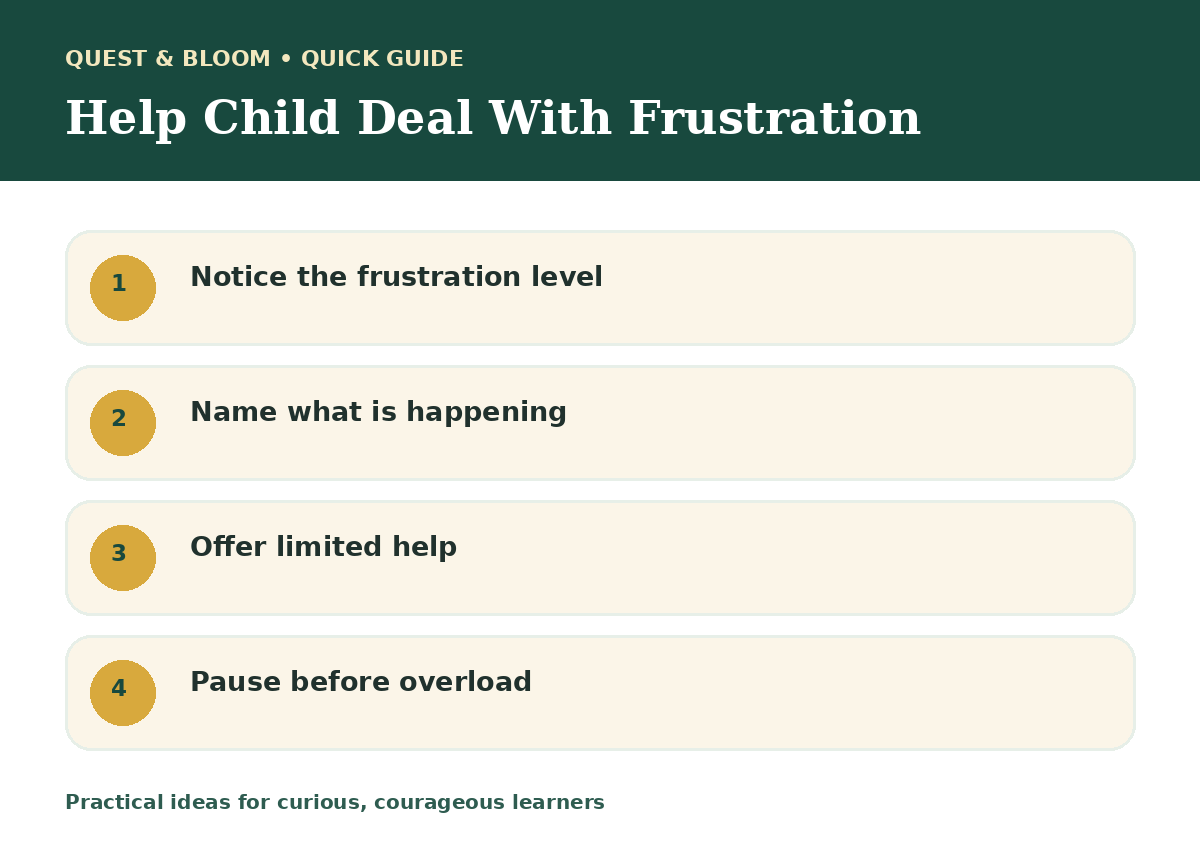
3. Offer two forms of help
Ask: “Would you like a clue, or would you like me to do the first step with you?” Two concrete choices are easier than “What do you need?” when a child is upset.
Then hand control back as soon as possible.
4. Teach a reset
Create a family reset that is not a punishment: hands off the task, one slow breath, drink of water, stretch, then decide whether to retry, change strategy or pause.
Practise the reset when nobody is upset so it is familiar.
5. Know when to stop
Growth does not require finishing every challenge in one sitting. If tiredness, hunger or repeated failure has taken over, pausing can be the mature strategy.
Say “We’re stopping for now, not because you can never do it, but because your brain has had enough for today.”
Related Quest & Bloom guides
- How to Teach Children to Learn From Mistakes Without Feeling Ashamed
- How to Help a Child Who Gives Up Easily: 10 Practical Strategies
- How to Build Resilience in Children Ages 4–8 Through Everyday Life
- How to Help Kids Cope With Losing Games Without Meltdowns
Frequently asked questions
Should I let my child get frustrated?
Some frustration is a normal part of learning. Stay available and adjust if it becomes overwhelming rather than productive.
What if they throw things?
Set the safety boundary first: “I won’t let you throw that.” Then help them regulate before returning to the task.
Will helping make them dependent?
Not if you scaffold. Give a clue, model one step or simplify the task, then return responsibility to the child.
Sources and further reading
- American Psychological Association — principles for families and learning
- Stanford — Carol Dweck on process praise, challenge and perseverance
- Harvard Center on the Developing Child — Serve and Return
Keep exploring: Our personalised children’s adventures are designed around curiosity, courage, problem-solving and learning through the story itself.
This article is general educational information for parents and carers. Children develop at different rates; seek appropriate professional advice for individual developmental, educational or health concerns.