Problem-solving is easier to practise when the outcome matters to the child: get the toy across the gap, protect the egg, decode the clue, build the shelter.
You do not need a worksheet. Household objects create better feedback because children can physically see whether an idea works.
If you are building these habits at home, explore our Growth Mindset hub and Quest & Bloom books for more practical ideas.
1. Build it
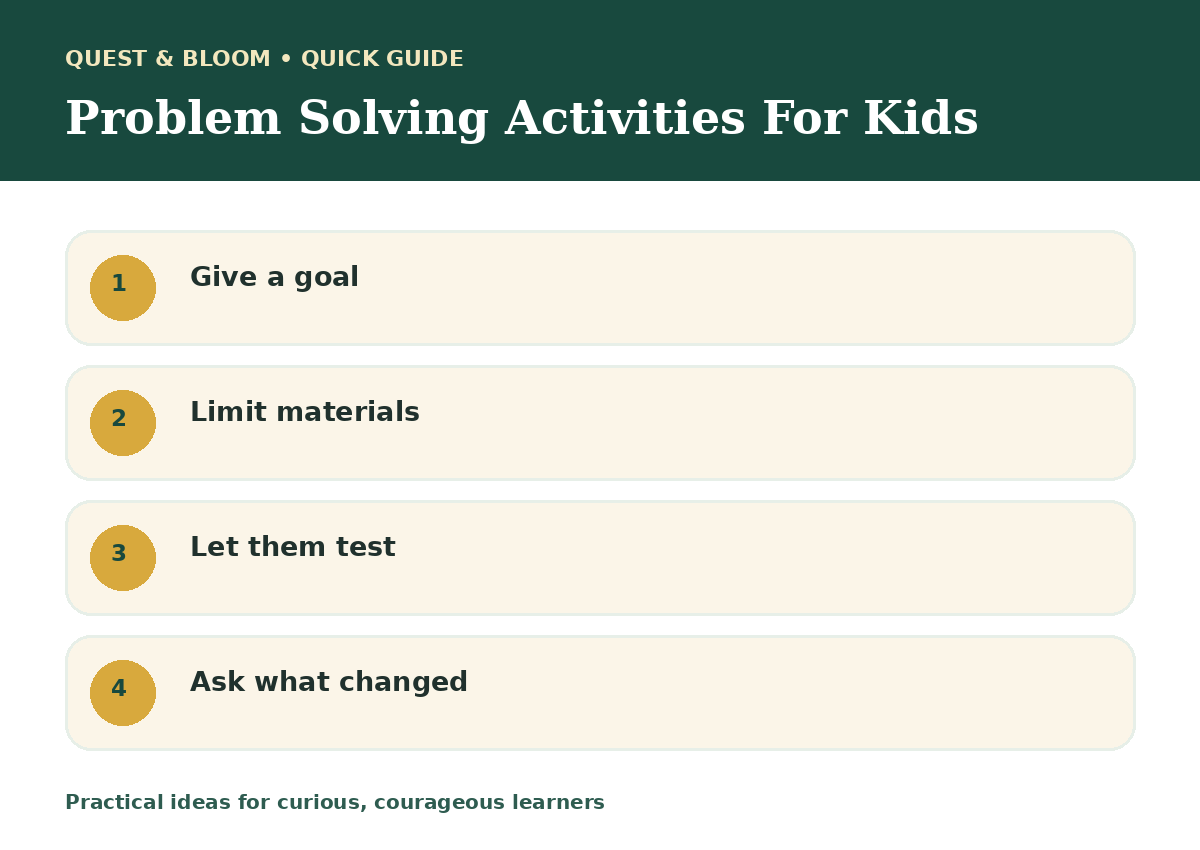
Construction challenges make thinking visible. Give a goal and a limited set of materials, then step back.
- Build a bridge from paper that holds five coins.
- Make a tower taller than a cereal box using 15 blocks.
- Build a shelter for a toy using only cardboard and tape.
2. Move it
Movement problems encourage planning and testing. Keep the rules simple and safe.
- Move a soft toy across the room without touching it with your hands.
- Create a ramp that sends a toy car as close as possible to a target.
- Move three cotton balls using only a spoon and a straw.
3. Find it
Treasure hunts can practise deduction rather than simple following if clues contain choices and information to combine.
- Give three clues that must be put in order.
- Hide two false clues and ask the child to explain which cannot be right.
- Draw a simple map with landmarks rather than written directions.
4. Fix it
Present a harmless problem and ask the child to diagnose it before changing anything.
- A block tower leans to one side.
- A paper aeroplane keeps diving.
- A marble track stops halfway.
5. Reflect on strategy
After the activity, focus on thinking rather than whether they succeeded quickly.
- What did you try first?
- What surprised you?
- What change made the biggest difference?
- What would you try if you had different materials?
Related Quest & Bloom guides
- Growth Mindset Activities for Kids: 15 Easy Ideas for Home
- Perseverance Activities for Kids: Fun Ways to Practise Not Giving Up
- How to Raise Curious Kids: 10 Ways to Encourage Questions and Exploration
Frequently asked questions
How much should parents help?
Wait long enough to let the child form an idea. If needed, ask a question or give one clue rather than demonstrating the whole solution.
What if my child gets the answer immediately?
Add a constraint: fewer materials, a longer distance or a second solution. The aim is thinking, not difficulty for its own sake.
Are problem-solving games educational?
They can support planning, flexibility and reasoning, especially when children actively test ideas rather than simply follow instructions.
Sources and further reading
- American Psychological Association — principles for families and learning
- Stanford — Carol Dweck on process praise, challenge and perseverance
- American Academy of Pediatrics — The Power of Play
Keep exploring: Our personalised children’s adventures are designed around curiosity, courage, problem-solving and learning through the story itself.
This article is general educational information for parents and carers. Children develop at different rates; seek appropriate professional advice for individual developmental, educational or health concerns.