Young children can produce a breathtaking number of questions. It is tempting to answer every one quickly, but curiosity is not just collecting facts. It is the habit of noticing gaps and wanting to investigate them.
Parents can nurture that habit without turning home into school.
If you are building these habits at home, explore our Growth Mindset hub and Quest & Bloom books for more practical ideas.
1. Replace some answers with joint investigation
When a child asks why leaves change colour or how a zip works, sometimes say “I’m not sure. How could we find out?”
This models that not knowing is a starting point rather than an embarrassment.
2. Ask observation questions
Questions such as “What do you notice?” and “What changed?” are often more useful than quiz questions with one correct answer.
They invite the child to look closely and contribute their own thinking.
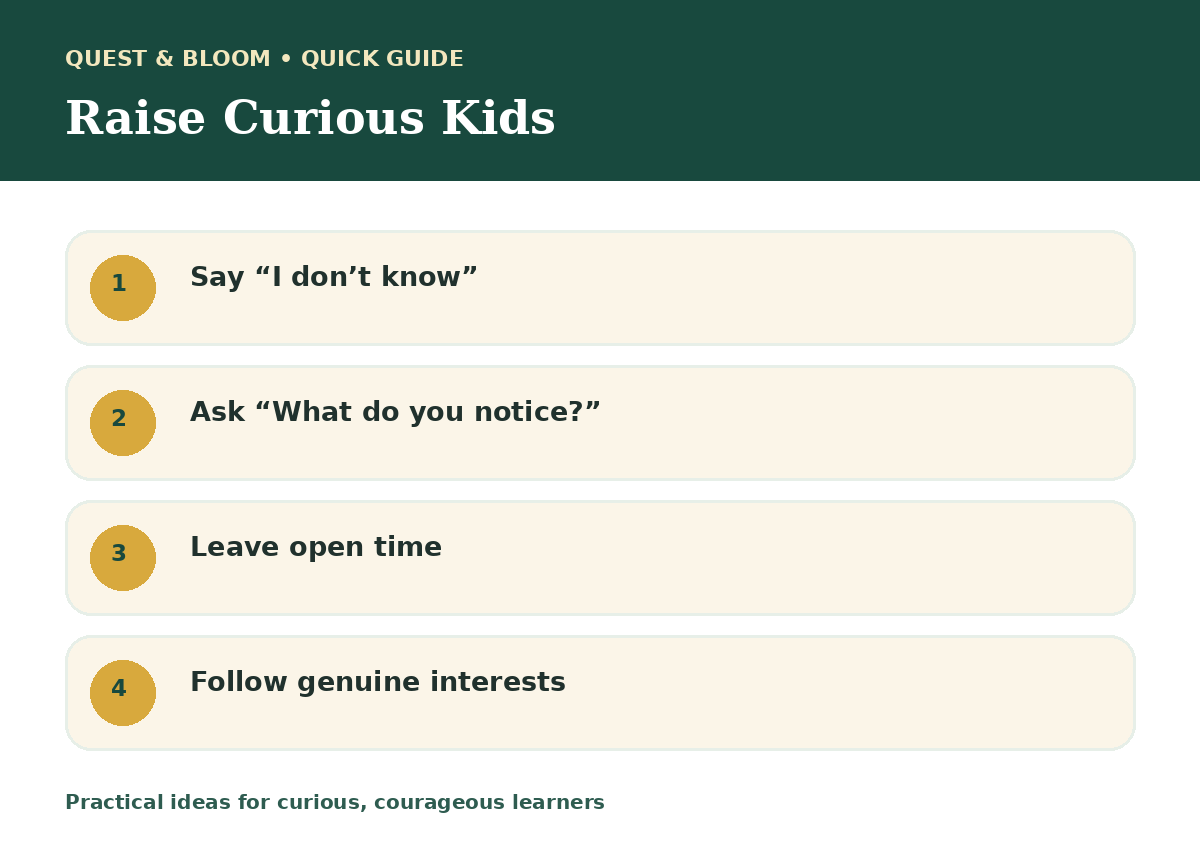
3. Leave room in the schedule
Curiosity needs unstructured time. A child who is moved rapidly from one organised activity to another has fewer chances to follow an unexpected interest.
Even short periods of open play or wandering outside can create questions.
4. Keep open-ended materials available
Cardboard, tape, blocks, paper, magnifiers, containers and natural objects can become many things.
Open-ended materials invite children to generate the purpose rather than simply follow a predetermined outcome.
5. Follow interests without turning them into homework
If a child loves dinosaurs, insects or trains, use the interest as a doorway to books, maps, drawing, measuring and imaginative play — but allow some fascination to remain simply enjoyable.
Curiosity dies quickly when every interest becomes a lesson plan.
Related Quest & Bloom guides
- 12 Problem-Solving Activities for Kids That Need Almost No Preparation
- How to Use Storybooks to Teach Growth Mindset Without Turning Reading Into a Lesson
- 25 Growth Mindset Questions to Ask Kids After School, Play and Challenges
Frequently asked questions
What if I do not know the answer to my child’s question?
Say so. Then decide together whether to look it up, experiment or leave it as a question for later.
Should I correct wrong explanations immediately?
If the misconception matters, correct it gently. Otherwise, first ask what makes the child think that and explore the reasoning.
Can screens support curiosity?
They can be useful tools for looking things up or seeing inaccessible places, but active discussion, making and real-world exploration add important depth.
Sources and further reading
- American Psychological Association — principles for families and learning
- Stanford — Carol Dweck on process praise, challenge and perseverance
- American Academy of Pediatrics — The Power of Play
- Harvard Center on the Developing Child — Serve and Return
Keep exploring: Our personalised children’s adventures are designed around curiosity, courage, problem-solving and learning through the story itself.
This article is general educational information for parents and carers. Children develop at different rates; seek appropriate professional advice for individual developmental, educational or health concerns.