“Never give up” sounds inspiring but is not a complete skill. Sometimes a child should persist; sometimes they should change strategy; sometimes they need help or rest.
The best perseverance activities let children experience that decision-making in a low-stakes setting.
If you are building these habits at home, explore our Growth Mindset hub and Quest & Bloom books for more practical ideas.
1. The five-minute challenge
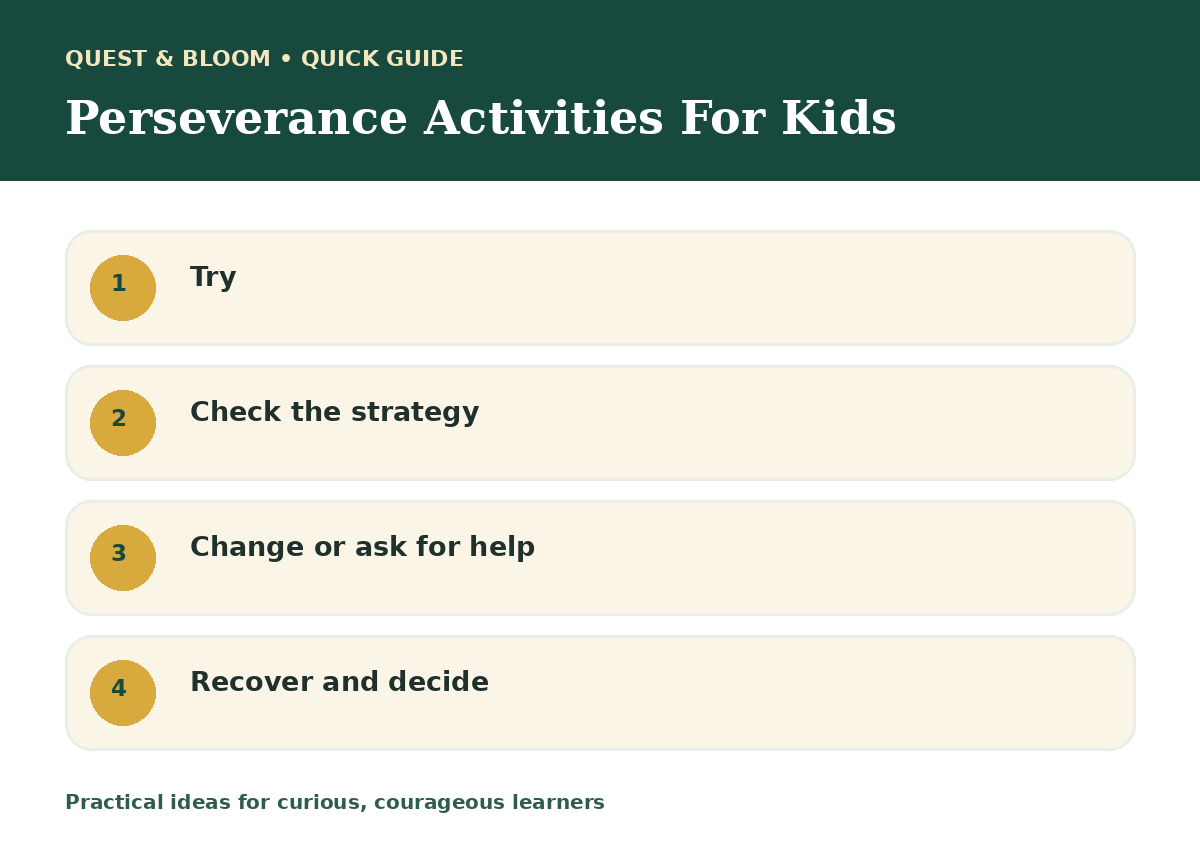
Choose a slightly difficult task and work on it for five minutes. At the end, decide together whether to continue, change strategy or pause.
This teaches that persistence can have a boundary and that stopping to reassess is not failure.
- Jigsaw section
- Cup stacking pattern
- Skipping practice
- Simple construction challenge
2. Three strategies before “I can’t”
Create a family habit: before deciding something is impossible, try up to three reasonable strategies.
The strategies can include asking for a clue. Help-seeking is a learning skill, not a loophole.
3. Repeat-and-compare challenges
Choose an activity where small improvement is visible: paper aeroplane distance, beanbag throws, balancing or drawing.
Compare the child with their own first attempt rather than another person.
4. Story perseverance spotting
While reading, look for moments when a character changes strategy, asks for help or tries again. Ask whether continuing was the best choice.
This helps children see that perseverance includes judgement.
5. Recovery practice
After a failed attempt, deliberately practise a reset: step away, breathe, identify one change, then decide whether to retry.
Recovery deserves as much attention as persistence itself.
Related Quest & Bloom guides
- Growth Mindset Activities for Kids: 15 Easy Ideas for Home
- How to Help a Child Who Gives Up Easily: 10 Practical Strategies
- 12 Problem-Solving Activities for Kids That Need Almost No Preparation
- A 7-Day Family Growth Mindset Challenge for Children Ages 4–8
Frequently asked questions
How do I teach perseverance without nagging?
Use small challenges, choices and time limits. Ask questions about strategy instead of repeating “keep trying”.
Should children finish every activity?
No. Teach the difference between quitting from a moment of frustration and making a considered decision to stop.
What if my child hates competitive tasks?
Use personal-best, cooperative and creative challenges where improvement is measured against their own previous attempt.
Sources and further reading
- American Psychological Association — principles for families and learning
- Stanford — Carol Dweck on process praise, challenge and perseverance
- American Academy of Pediatrics — The Power of Play
Keep exploring: Our personalised children’s adventures are designed around curiosity, courage, problem-solving and learning through the story itself.
This article is general educational information for parents and carers. Children develop at different rates; seek appropriate professional advice for individual developmental, educational or health concerns.