“I give up!” can trigger an adult instinct to push harder: “You haven’t even tried.” But quitting quickly is information. The child may not understand the task, may expect instant success, may be tired, or may be avoiding the feeling of getting something wrong.
Persistence grows when children experience challenges that are difficult enough to matter but supported enough to survive.
If you are building these habits at home, explore our Growth Mindset hub and Quest & Bloom books for more practical ideas.
1. Ask why the task feels impossible
Instead of assuming laziness, ask the child to show you the sticking point. Sometimes the missing piece is tiny: one unknown word, one instruction they misunderstood or uncertainty about where to start.
Fixing the entry point can transform the whole task.
2. Shrink the target
Large goals create an all-or-nothing feeling. Replace “finish the worksheet” with “let’s do the first two questions”. Replace “tidy your room” with “put the books on the shelf”.
Success on a smaller unit gives the child evidence that action is possible.
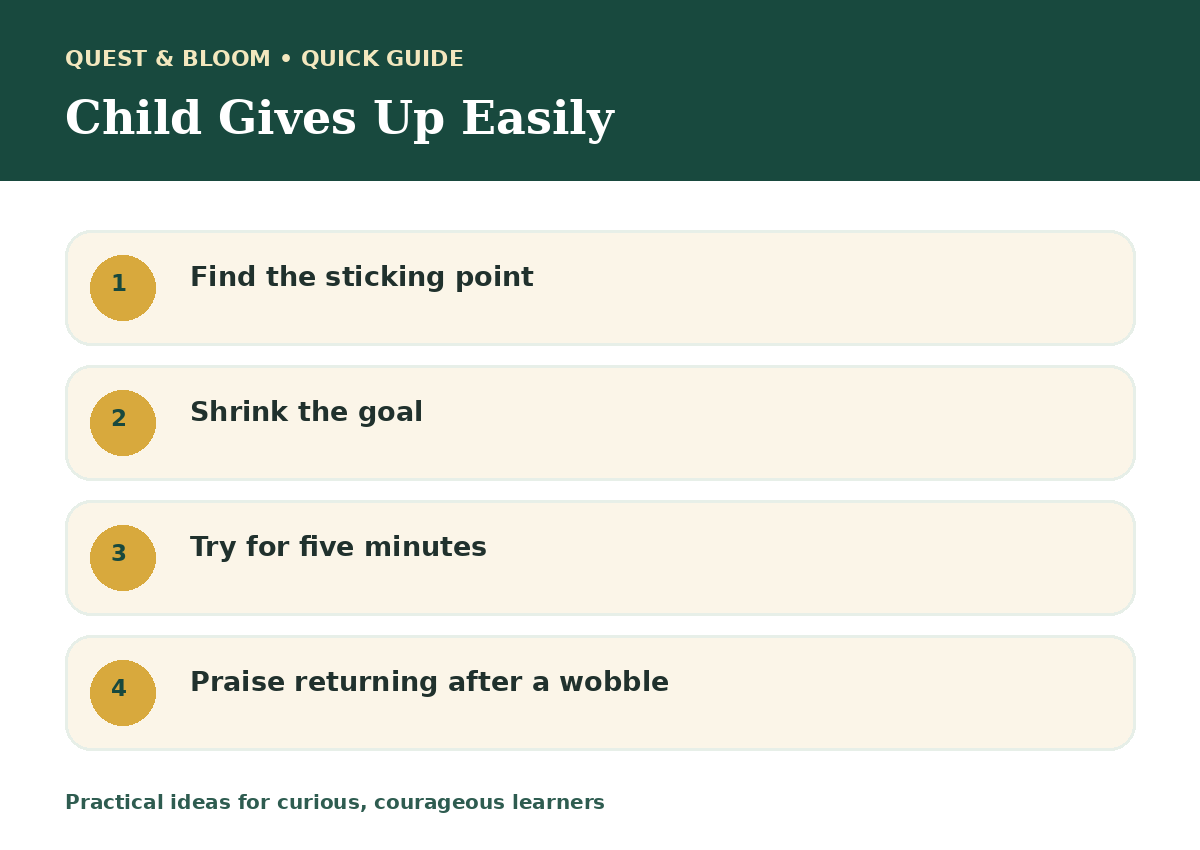
3. Use a short persistence window
Try a timer for three or five minutes, but frame it as a manageable experiment rather than punishment. “Let’s work on it until the timer, then decide what to do next.”
This removes the fear of being trapped in a difficult task indefinitely.
4. Teach strategy changes
Persistence is not doing the same ineffective thing forever. Ask what could change: tool, order, position, pace, example, partner or environment.
Children who know several strategies are less likely to interpret difficulty as a dead end.
- Ask for a clue.
- Use a worked example.
- Change location.
- Take a brief break.
- Try a different tool.
5. Notice recovery
Do not only praise completion. Notice the moment the child returns after frustration: “You were ready to stop, took a minute, and came back.”
Recovery is one of the most useful resilience skills to reinforce.
Related Quest & Bloom guides
- How to Build Resilience in Children Ages 4–8 Through Everyday Life
- How to Help a Child Deal With Frustration Without Taking Over
- Perseverance Activities for Kids: Fun Ways to Practise Not Giving Up
- Growth Mindset at Home: A Simple Daily Routine for Busy Parents
Frequently asked questions
Should I force my child to finish what they start?
Not as a blanket rule. Some commitments matter, but persistence also includes knowing when to pause, change strategy or decide an activity is not worthwhile.
How much help is too much?
Give the least help that allows progress: a question, clue or first step before taking over the whole task.
What if they only persist when rewarded?
Gradually shift attention from the reward to progress, mastery, choice and satisfaction. External rewards can be useful sometimes, but they should not become the only reason to continue.
Sources and further reading
- American Psychological Association — principles for families and learning
- Stanford — Carol Dweck on process praise, challenge and perseverance
Keep exploring: Our personalised children’s adventures are designed around curiosity, courage, problem-solving and learning through the story itself.
This article is general educational information for parents and carers. Children develop at different rates; seek appropriate professional advice for individual developmental, educational or health concerns.