Children are more likely to believe “I can handle things” when they have memories of actually handling things. That is why practical experiences can be more powerful than telling a hesitant child to “be confident”.
The activities below focus on agency, competence and connection rather than performance.
If you are building these habits at home, explore our Growth Mindset hub and Quest & Bloom books for more practical ideas.
1. Give them something real to own
Choose a household responsibility the child can learn properly. Real contribution sends the message that they are capable and needed.
- Feed a pet.
- Prepare napkins for dinner.
- Check everyone has a water bottle.
- Pack one part of their school or activity bag.
2. Practise small acts of independence
Confidence often grows at the edge of familiar routines. Let the child order their own drink, ask a librarian where a book is or pay for a small item while you stand nearby.
Keep the step small enough that success is plausible.
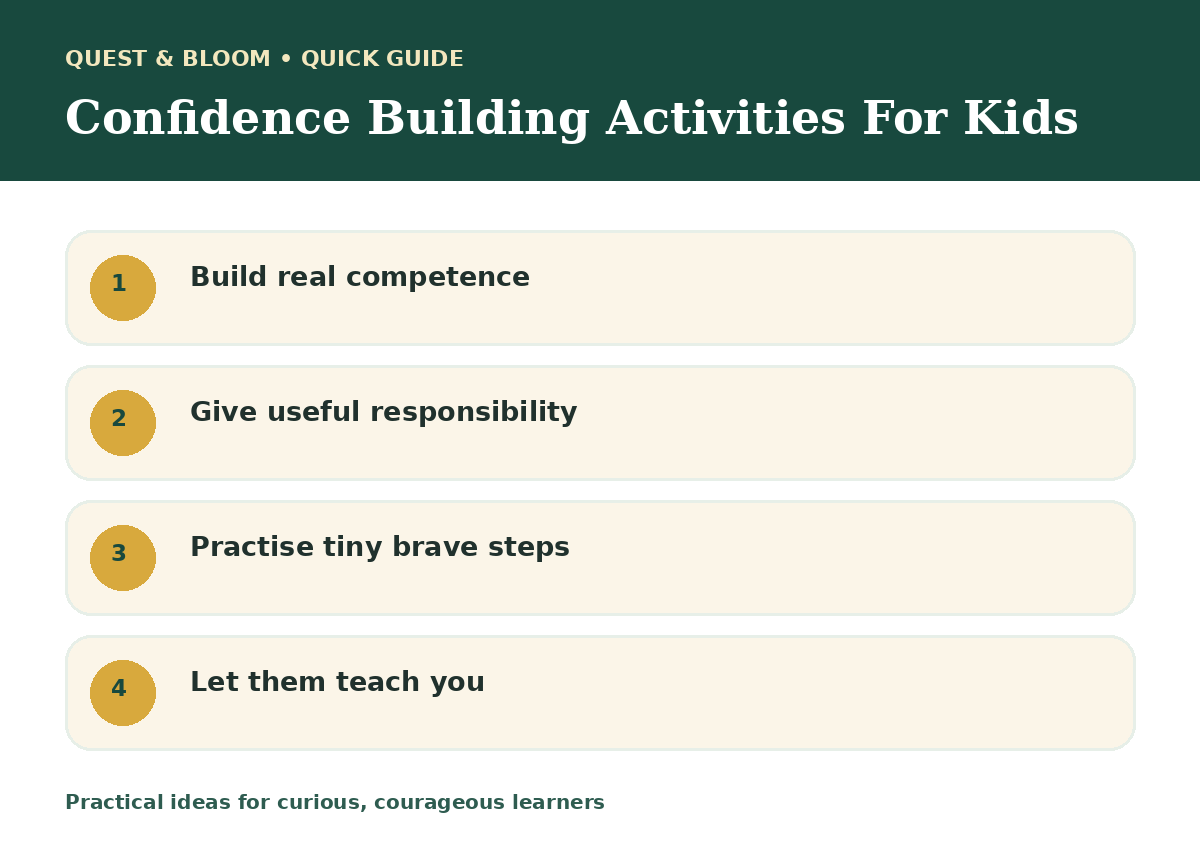
3. Teach a skill in visible stages
Choose a practical skill and show progress: tying a simple knot, cracking an egg, using a ruler, folding clothes or riding a scooter.
Name the stage they can now do without help.
4. Create a “teach me” moment
Ask the child to teach you something they know: a game rule, a dance, a fact about dinosaurs or how their Lego mechanism works.
Being the knowledgeable person for a moment can strengthen competence without artificial praise.
5. Use courage ladders
For something intimidating, draw three to five steps from easiest to hardest. A child nervous about a new club might first visit the building, then watch, then join for ten minutes.
Confidence often follows action rather than appearing before it.
Related Quest & Bloom guides
- How to Build Resilience in Children Ages 4–8 Through Everyday Life
- How to Encourage Independence in Young Children Without Pushing Too Hard
- How to Raise Curious Kids: 10 Ways to Encourage Questions and Exploration
Frequently asked questions
Are affirmations good for confidence?
They can be pleasant, but confidence is stronger when words are connected to real experiences and evidence of competence.
Should I push a shy child to speak to people?
Use gradual, supported steps rather than sudden pressure. Respect temperament while still creating gentle opportunities to practise.
How can I help after a confidence knock?
Return to a manageable task, notice existing skills and build back through successful experiences rather than arguing with the child’s feelings.
Sources and further reading
- American Psychological Association — principles for families and learning
- Stanford — Carol Dweck on process praise, challenge and perseverance
- American Academy of Pediatrics — The Power of Play
Keep exploring: Our personalised children’s adventures are designed around curiosity, courage, problem-solving and learning through the story itself.
This article is general educational information for parents and carers. Children develop at different rates; seek appropriate professional advice for individual developmental, educational or health concerns.