“How was school?” often earns “fine”. More specific questions can open richer conversations, especially when they ask about a moment rather than demanding a summary of the entire day.
Growth mindset questions focus on learning processes: challenge, strategy, help, mistakes, improvement and curiosity.
If you are building these habits at home, explore our Growth Mindset hub and Quest & Bloom books for more practical ideas.
1. Questions about challenge
These help children notice difficulty without treating it as failure.
- What was tricky today?
- Was there something that looked hard before you started?
- What took more than one attempt?
- When did you nearly stop?
- What challenge are you glad you tried?
2. Questions about strategy
Strategy questions build awareness of how learning happens.
- What helped you figure something out?
- Did you change your plan at any point?
- What did you do when you got stuck?
- Who or what gave you a useful clue?
- What would you try differently next time?
3. Questions about mistakes
Keep the tone curious rather than evaluative.
- Did anything go wrong in an interesting way?
- What mistake taught you something?
- Was there an answer you changed?
- What did you notice after it did not work?
- Did anyone help you fix something?
4. Questions about progress
These shift comparison toward the child’s own development.
- What feels easier than it did last week?
- What can you do now that needed help before?
- What did you practise today?
- What are you getting faster or steadier at?
- What still needs more time?
5. Questions about curiosity
Learning is not only performance. Curiosity keeps the conversation broader.
- What made you wonder today?
- Did you hear a surprising fact?
- What question do you still have?
- What would you like to investigate?
- What did someone else know that you found interesting?
Related Quest & Bloom guides
- Growth Mindset for Kids: 12 Practical Ways to Help Children Learn, Persist and Grow
- 35 Growth Mindset Phrases for Kids That Parents Can Actually Use
- How to Use Storybooks to Teach Growth Mindset Without Turning Reading Into a Lesson
- Growth Mindset at Home: A Simple Daily Routine for Busy Parents
Frequently asked questions
How many questions should I ask?
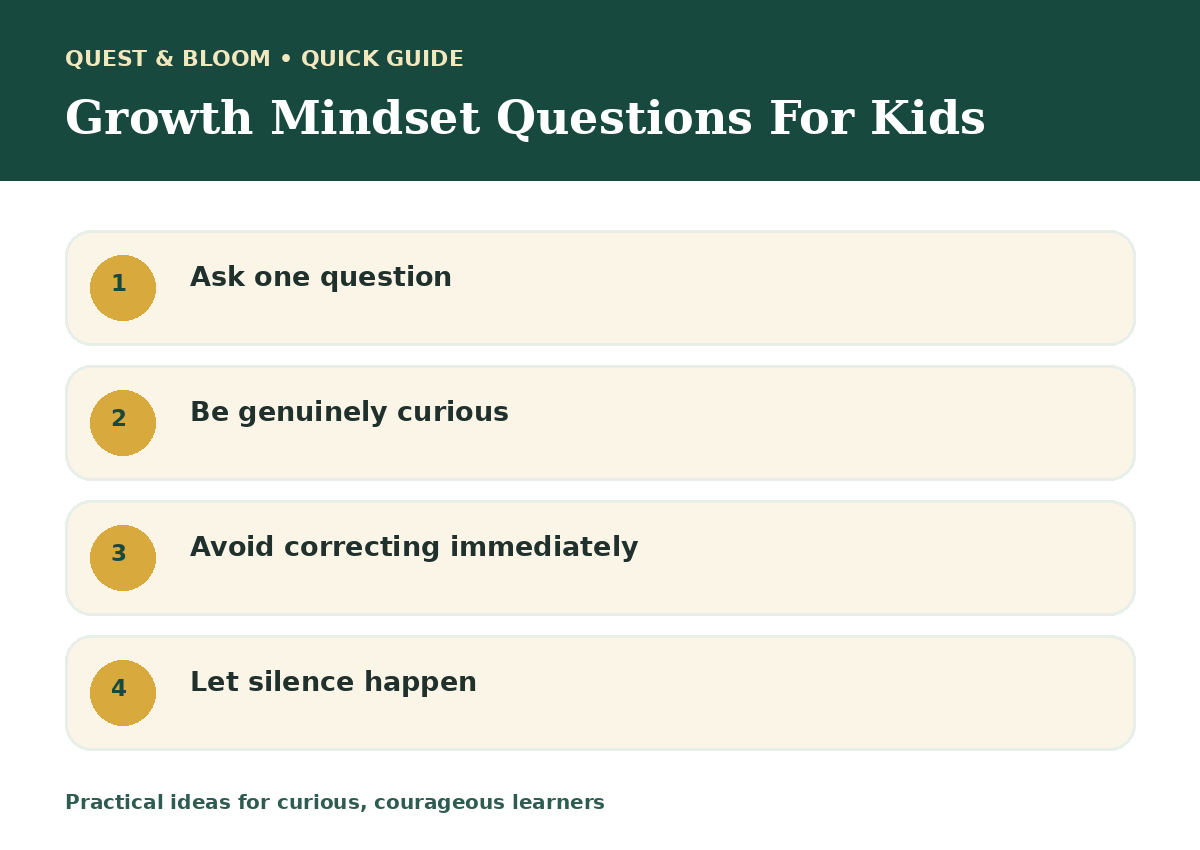
Usually one or two. A long sequence can feel like an interview.
What if my child does not want to talk after school?
Give decompression time and try later during a snack, walk or bedtime. Some children talk more easily side-by-side than face-to-face.
Should I correct negative answers?
Listen first. If the child says “I was terrible at everything,” acknowledge the feeling and later help make the statement more specific.
Sources and further reading
- American Psychological Association — principles for families and learning
- Stanford — Carol Dweck on process praise, challenge and perseverance
Keep exploring: Our personalised children’s adventures are designed around curiosity, courage, problem-solving and learning through the story itself.
This article is general educational information for parents and carers. Children develop at different rates; seek appropriate professional advice for individual developmental, educational or health concerns.