Children are not either “growth mindset children” or “fixed mindset children”. A child may happily experiment with Lego and become extremely fixed about reading. Mindset changes with context, confidence and past experience.
For parents, the useful question is not “Which mindset does my child have?” but “What response would help them see a path forward in this moment?”
If you are building these habits at home, explore our Growth Mindset hub and Quest & Bloom books for more practical ideas.
1. What a fixed mindset sounds like
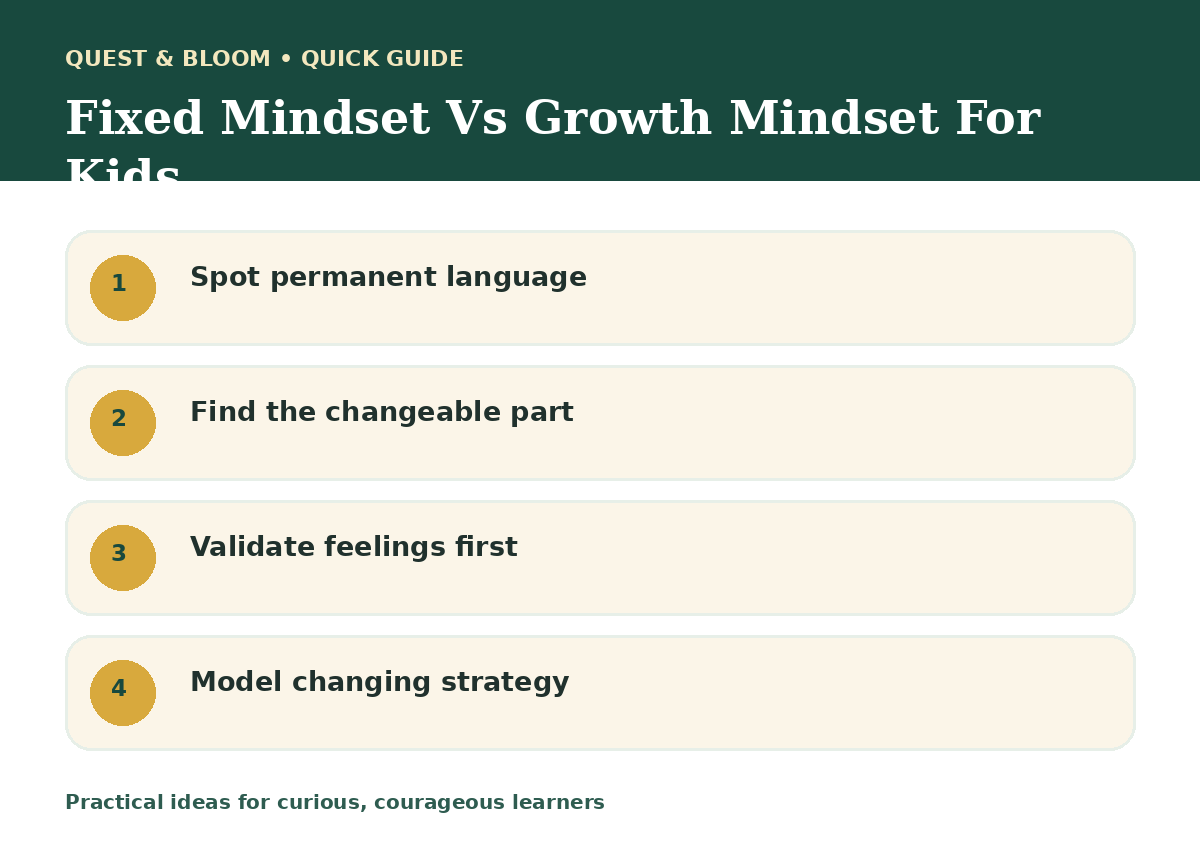
Fixed statements usually turn a temporary difficulty into an identity or permanent prediction. Listen for words such as always, never, just, naturally and impossible.
- “I’m just bad at maths.”
- “She’s naturally better than me.”
- “If I get it wrong people will know I’m stupid.”
- “There’s no point practising.”
2. What a growth-oriented response sounds like
A growth response does not deny the difficulty. It identifies something changeable: knowledge, strategy, practice, support or time.
- “I don’t understand this part yet.”
- “I need another way to practise.”
- “Can you show me the first step?”
- “I improved that bit; now I need to work on this one.”
3. Examples from real family life
In sport, a fixed response might be “I missed, so I’m terrible.” A useful parent response is “What changed between the kick that worked and the one that missed?”
In art, avoid correcting “I can’t draw hands” with “Of course you can.” Try “Hands are tricky. Let’s look at the shapes and try one finger at a time.”
- Reading: isolate the difficult word rather than the whole book.
- Games: separate losing from being a loser.
- Chores: teach the missing step rather than labelling the child lazy.
4. Why emotions matter
A child who is ashamed or overwhelmed is less able to think flexibly. Growth mindset language works poorly when it is used to override genuine feelings.
Validate first, then coach. “You are really disappointed that you lost” can come before “When you’re ready, shall we think about what you might try next time?”
5. How parents can model flexibility
Say out loud when you revise an opinion, learn a skill or notice a mistake. Children need examples of adults changing their minds and strategies without embarrassment.
Model phrases such as “I was wrong about that,” “I need to practise,” and “I don’t know yet — let’s find out.”
Related Quest & Bloom guides
- Growth Mindset for Kids: 12 Practical Ways to Help Children Learn, Persist and Grow
- How to Teach Children to Learn From Mistakes Without Feeling Ashamed
- 9 Growth Mindset Mistakes Parents Make — and What to Do Instead
Frequently asked questions
Can a child have both fixed and growth mindsets?
Yes. Mindset can vary by task and situation. That is normal and more useful than treating mindset as a personality label.
Is a growth mindset the same as confidence?
No. Confidence is how capable someone feels; growth mindset is a belief about whether ability can develop. A child can feel unsure and still believe they can improve.
Does growth mindset mean every child can become equally good at everything?
No. Children differ in strengths, interests, opportunities and needs. The useful idea is that learning and improvement are possible, not that everyone reaches identical outcomes.
Sources and further reading
- American Psychological Association — principles for families and learning
- Stanford — Carol Dweck on process praise, challenge and perseverance
Keep exploring: Our personalised children’s adventures are designed around curiosity, courage, problem-solving and learning through the story itself.
This article is general educational information for parents and carers. Children develop at different rates; seek appropriate professional advice for individual developmental, educational or health concerns.