Growth mindset is a useful idea, but popular versions can drift far from the practical point. “Just try harder” is not a complete learning strategy, and “you can do anything” is not always credible.
These are the mistakes most likely to turn a helpful concept into pressure.
If you are building these habits at home, explore our Growth Mindset hub and Quest & Bloom books for more practical ideas.
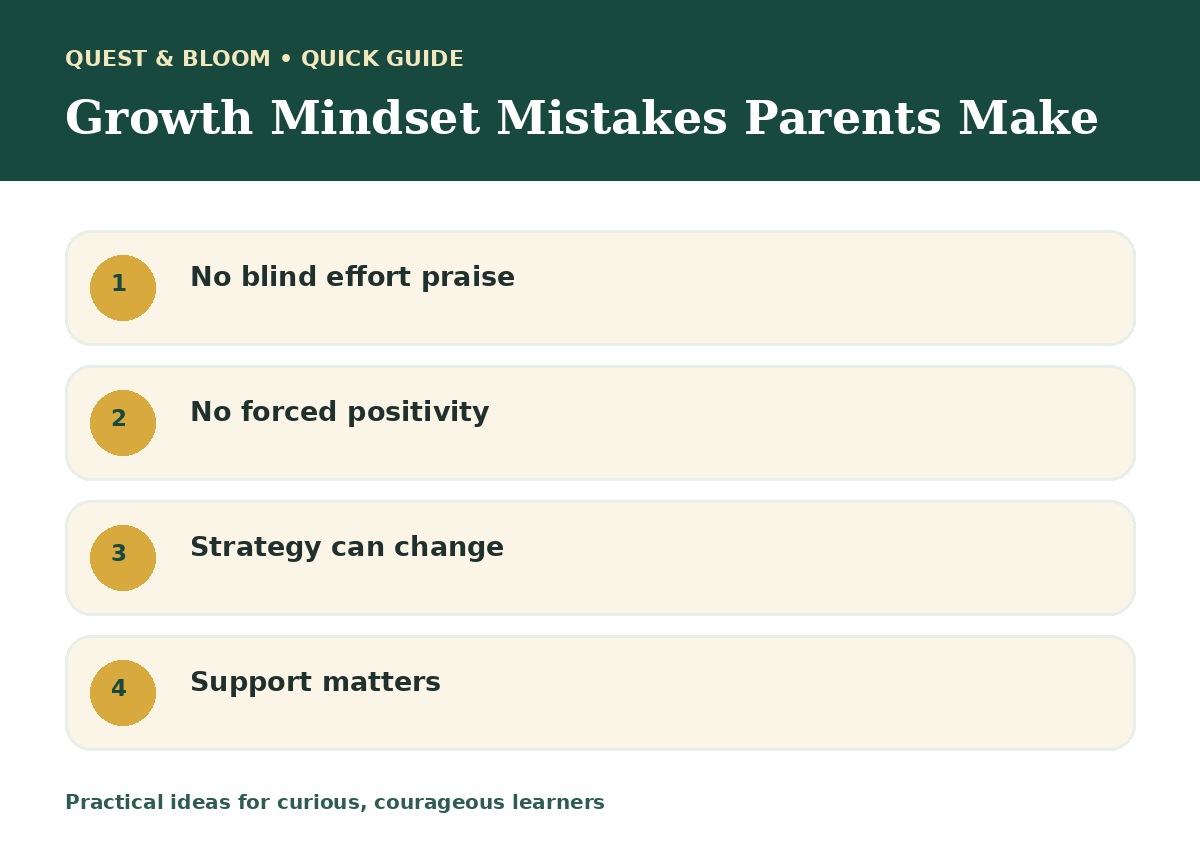
1. Praising effort even when the strategy is failing
Effort deserves acknowledgement, but repeating an ineffective method is not the goal. Ask whether the approach is producing information or progress.
Teach the child to change strategy, seek help or pause.
2. Using “yet” as a correction
Responding to every “I can’t” with “yet!” can feel like the adult is not listening. First understand what is hard, then use “yet” if it leads to a realistic next step.
Language should serve the child, not the concept.
3. Treating every mistake as wonderful
Some mistakes are disappointing or inconvenient. Children do not need to celebrate them. They need to know mistakes can be examined and repaired.
A calm “Okay, what does that tell us?” is enough.
4. Ignoring emotion
A child who is overwhelmed is not ready for a lesson about neuroplasticity. Regulate first. Growth mindset should never become a way to dismiss frustration or sadness.
Connection often makes later problem-solving possible.
5. Confusing persistence with never stopping
Healthy learning includes breaks, help, strategy changes and sometimes deciding to stop. “Never quit” can teach children to ignore useful information.
Ask: Is this still a worthwhile challenge? What would make another attempt different?
6. Comparing siblings
“Your sister practised and now she can do it” may be intended as encouragement but can turn growth into competition.
Compare the child with their own previous work instead.
7. Overpraising everything
Constant evaluation can make children watch adults for approval. Use neutral noticing as well as praise.
“You did that part by yourself” can be enough.
8. Expecting one mindset everywhere
A child can be adventurous in sport and fixed about handwriting. Work with the specific context rather than labelling the child.
Mindset is a response pattern, not an identity.
9. Forgetting the environment
Children cannot strategy their way out of every barrier. Sometimes they need clearer teaching, adapted materials, rest, extra practice or professional support.
A growth mindset includes using resources, not pretending effort solves everything.
Related Quest & Bloom guides
- Growth Mindset for Kids: 12 Practical Ways to Help Children Learn, Persist and Grow
- 35 Growth Mindset Phrases for Kids That Parents Can Actually Use
- How to Praise Children Effectively: 30 Process Praise Examples
Frequently asked questions
Can growth mindset put pressure on children?
Yes, if adults turn it into a demand to keep trying regardless of emotion, strategy or circumstances. Use it as a framework for learning, not a moral test.
Is fixed mindset language always bad?
No. Everyone uses fixed language sometimes. Treat it as a cue to explore the situation rather than a behaviour to police.
Should schools and parents use the same language?
Consistency can help, but natural language matters more than identical slogans.
Sources and further reading
- American Psychological Association — principles for families and learning
- Stanford — Carol Dweck on process praise, challenge and perseverance
Keep exploring: Our personalised children’s adventures are designed around curiosity, courage, problem-solving and learning through the story itself.
This article is general educational information for parents and carers. Children develop at different rates; seek appropriate professional advice for individual developmental, educational or health concerns.