Parents do not need a perfect script every time a child gets frustrated. In fact, overly polished motivational lines can sound false when a child is upset.
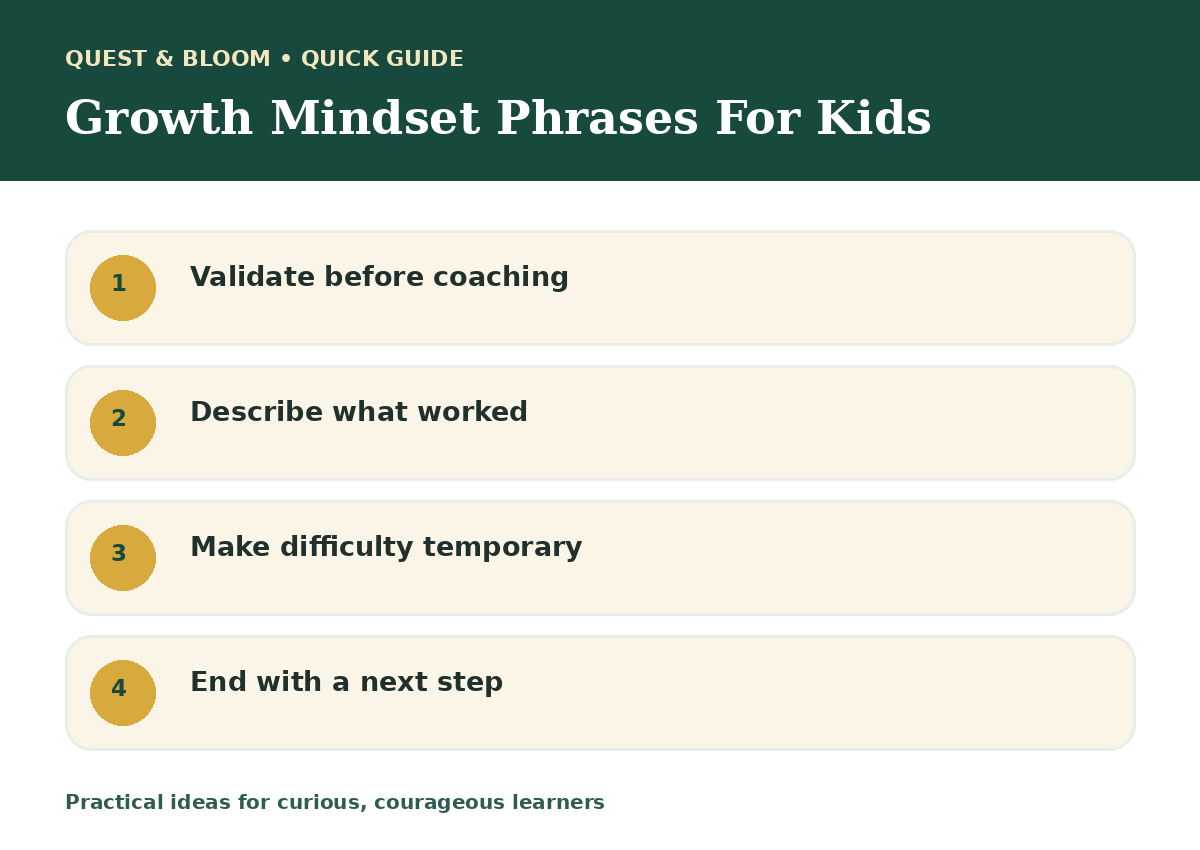
The most useful phrases tend to do one of four jobs: validate the feeling, separate difficulty from identity, notice an effective process, or help the child choose a next move.
If you are building these habits at home, explore our Growth Mindset hub and Quest & Bloom books for more practical ideas.
1. When a child says “I can’t”
Do not rush to contradict them with “Yes you can!” They may be accurately describing how the task feels right now. Acknowledge the difficulty, then make the statement less permanent.
- “You can’t do that yet. Which part could we practise?”
- “Show me the bit where you get stuck.”
- “What do you already know how to do?”
- “Would a hint help, or do you want another try?”
- “Let’s make the next step smaller.”
2. When something goes wrong
After a mistake, lower the emotional temperature before analysing it. Once the child is calmer, use language that turns the result into information.
- “That didn’t go how you hoped.”
- “What did that show us?”
- “Which bit worked before it went wrong?”
- “What is one thing you could change?”
- “Do you want to try again now or after a break?”
3. When you want to praise
Specific praise teaches more than a global label. Name the behaviour, decision or strategy that mattered.
- “You checked your work before saying you were finished.”
- “You changed your plan when the first one failed.”
- “You stayed focused even when it got noisy.”
- “You asked for help at a useful time.”
- “You practised that part and it became easier.”
4. When a child is comparing themselves
Comparison can make ability feel fixed. Bring attention back to the child’s own learning and to what they can learn from others.
- “They have practised that a lot. What could you learn from watching?”
- “Let’s compare this with your last attempt.”
- “Everyone has different things they are learning.”
- “Being behind today does not tell us where you will be later.”
- “What would progress look like for you?”
5. When effort is not working
Growth mindset is not endless repetition. Teach children that changing strategy is part of persistence.
- “You have worked hard. Is this strategy helping?”
- “What else could we try?”
- “Would different tools make this easier?”
- “Who could give us a useful clue?”
- “Maybe the brave choice is to pause and come back.”
Related Quest & Bloom guides
- Growth Mindset for Kids: 12 Practical Ways to Help Children Learn, Persist and Grow
- How to Praise Children Effectively: 30 Process Praise Examples
- 25 Growth Mindset Questions to Ask Kids After School, Play and Challenges
- 9 Growth Mindset Mistakes Parents Make — and What to Do Instead
Frequently asked questions
Is saying “you’re clever” harmful?
A single compliment is not a problem. The useful change is to add specific feedback about what the child did, so success is not explained only as a fixed trait.
Should I use the word “yet” every time?
No. Use it naturally and pair it with a realistic next step. Repeating it mechanically can sound dismissive.
What should I say when my child is very upset?
Regulate first. A simple “You’re really disappointed” may be more useful than a lesson. Problem-solving can wait until the child is calmer.
Sources and further reading
- American Psychological Association — principles for families and learning
- Stanford — Carol Dweck on process praise, challenge and perseverance
Keep exploring: Our personalised children’s adventures are designed around curiosity, courage, problem-solving and learning through the story itself.
This article is general educational information for parents and carers. Children develop at different rates; seek appropriate professional advice for individual developmental, educational or health concerns.