Independence is not a child doing everything alone. Young children become independent through a long process of supported practice.
The useful question is: “What part of this can my child reasonably own today?” That might be choosing clothes, ordering their own drink, packing the swimming goggles or spreading butter on toast.
If you are building these habits at home, explore our Growth Mindset hub and Quest & Bloom books for more practical ideas.
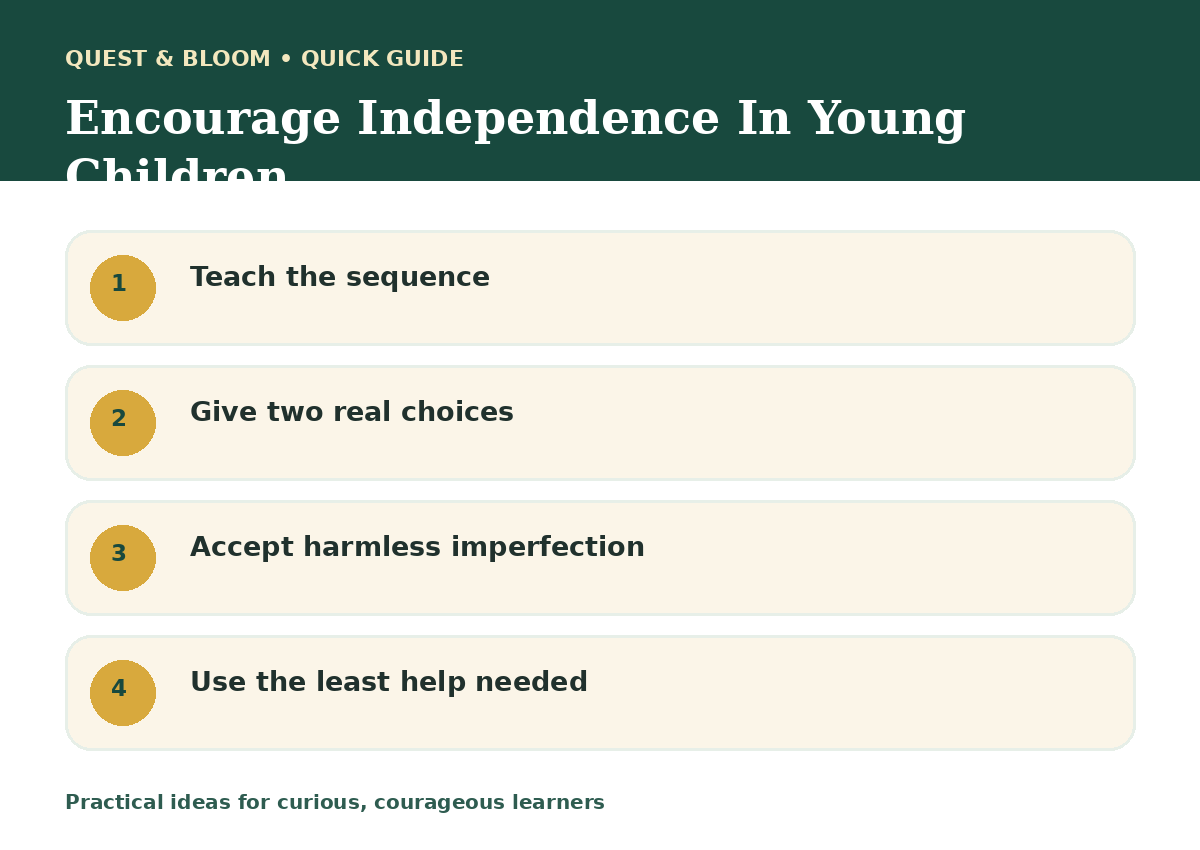
1. Teach before expecting
Adults often give an instruction such as “get ready” without realising how many steps it contains. Break routines down and teach them explicitly.
A visual sequence can help: socks, shoes, coat, bag. Once the sequence is familiar, reduce prompts.
2. Offer meaningful choices
Choice builds agency when both options are acceptable. “Red jumper or green jumper?” is a real choice. “Do you want to leave the park?” is not if leaving is compulsory.
Keep the number of options small for younger children.
3. Give ownership of useful jobs
Real contribution feels different from a pretend task. Let the child carry light shopping, check the family has water bottles or feed a pet.
Match the job to the child’s ability and environment, and expect to teach it more than once.
4. Resist correcting every detail
If the bed is lumpy but made, or the clothes are not perfectly folded, decide whether perfection matters. Constant correction teaches that independence still ends with an adult redoing the task.
Intervene for safety and important standards; allow harmless imperfection.
5. Use the least-help rule
When the child is stuck, start with the smallest support: a reminder, then a hint, then modelling one step, and only then direct help.
This keeps the child in control of as much of the task as possible.
Related Quest & Bloom guides
- 15 Confidence-Building Activities for Kids Ages 4–8
- How to Raise Curious Kids: 10 Ways to Encourage Questions and Exploration
- Growth Mindset at Home: A Simple Daily Routine for Busy Parents
Frequently asked questions
What should a 5-year-old do independently?
Abilities vary widely. Focus on tasks the child has been taught and can complete safely, such as dressing parts of themselves, carrying belongings or helping with simple household jobs.
What if doing it themselves takes forever?
Build extra time into low-pressure moments. When time is genuinely tight, say so and help without pretending it is a lesson in independence.
Should I pay children for chores?
Families approach this differently. Basic contribution can be treated as part of family life, while optional extra jobs may be handled separately.
Sources and further reading
- American Psychological Association — principles for families and learning
- Stanford — Carol Dweck on process praise, challenge and perseverance
- Harvard Center on the Developing Child — Serve and Return
Keep exploring: Our personalised children’s adventures are designed around curiosity, courage, problem-solving and learning through the story itself.
This article is general educational information for parents and carers. Children develop at different rates; seek appropriate professional advice for individual developmental, educational or health concerns.