Praise is most useful when it helps a child understand what they did that worked. “Amazing!” communicates warmth, but “You checked the corners first and that helped you finish the puzzle” provides information.
This does not require parents to narrate every action. Select moments when the feedback genuinely helps the child recognise a useful habit.
If you are building these habits at home, explore our Growth Mindset hub and Quest & Bloom books for more practical ideas.
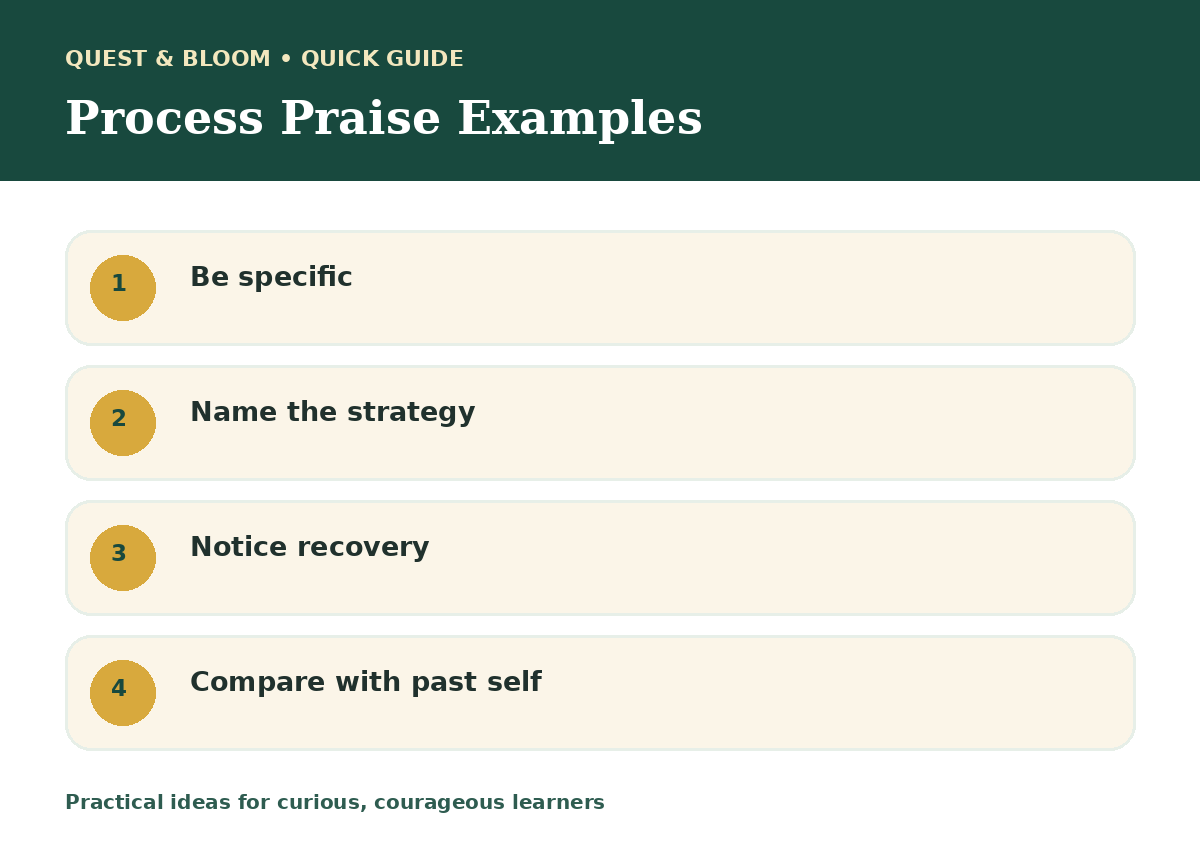
1. Praise strategy
Strategy praise makes success repeatable because it points to the method.
- “Sorting the pieces by colour helped you find them faster.”
- “You sounded the word out one part at a time.”
- “You moved the bigger blocks to the bottom and made it steadier.”
- “You checked the example when you got stuck.”
- “You tried a different route instead of repeating the first one.”
2. Praise persistence and recovery
Notice not just staying with a task but returning after a wobble.
- “You were frustrated, took a break and came back.”
- “You kept working until you found the part that was wrong.”
- “You tried again after the first one fell.”
- “You asked for help and then finished the next part yourself.”
- “You didn’t let one mistake decide the whole activity.”
3. Praise focus and preparation
Children benefit from seeing that success often begins before the final result.
- “You got everything ready before you started.”
- “You listened to the instructions and checked the first step.”
- “You kept your eyes on the ball that time.”
- “You slowed down on the tricky section.”
- “You remembered what helped yesterday.”
4. Praise courage and curiosity
Trying something uncertain is worth noticing even when the result is ordinary.
- “You asked a question even though you weren’t sure.”
- “You tried the new slide after watching first.”
- “You tasted something unfamiliar.”
- “You showed your idea even though it wasn’t finished.”
- “You experimented to see what would happen.”
5. Praise improvement and reflection
Comparison with the child’s own earlier work supports a sense of progress.
- “Your letters are easier to read than last month.”
- “You spotted the mistake yourself.”
- “That second plan solved the problem.”
- “You can do that step without my reminder now.”
- “You noticed exactly what you want to practise next.”
Related Quest & Bloom guides
- Growth Mindset for Kids: 12 Practical Ways to Help Children Learn, Persist and Grow
- 35 Growth Mindset Phrases for Kids That Parents Can Actually Use
- 9 Growth Mindset Mistakes Parents Make — and What to Do Instead
Frequently asked questions
Do I have to stop saying “good job”?
No. Warm spontaneous praise is part of normal relationships. Add specific process feedback when it would help the child understand their learning.
Can too much praise be a problem?
Constant praise can make children dependent on external approval. Not every ordinary action needs evaluation.
What is the difference between praise and encouragement?
Praise often evaluates a result or behaviour. Encouragement can simply notice progress, feelings or effort without rating the child.
Sources and further reading
- American Psychological Association — principles for families and learning
- Stanford — Carol Dweck on process praise, challenge and perseverance
Keep exploring: Our personalised children’s adventures are designed around curiosity, courage, problem-solving and learning through the story itself.
This article is general educational information for parents and carers. Children develop at different rates; seek appropriate professional advice for individual developmental, educational or health concerns.