For adults, a spelling error or toppled tower may seem tiny. For a young child, it can feel like evidence that they are incapable, embarrassed or behind everyone else.
Children learn from mistakes best when the mistake is emotionally safe enough to examine. That means connection and calm come before analysis.
If you are building these habits at home, explore our Growth Mindset hub and Quest & Bloom books for more practical ideas.
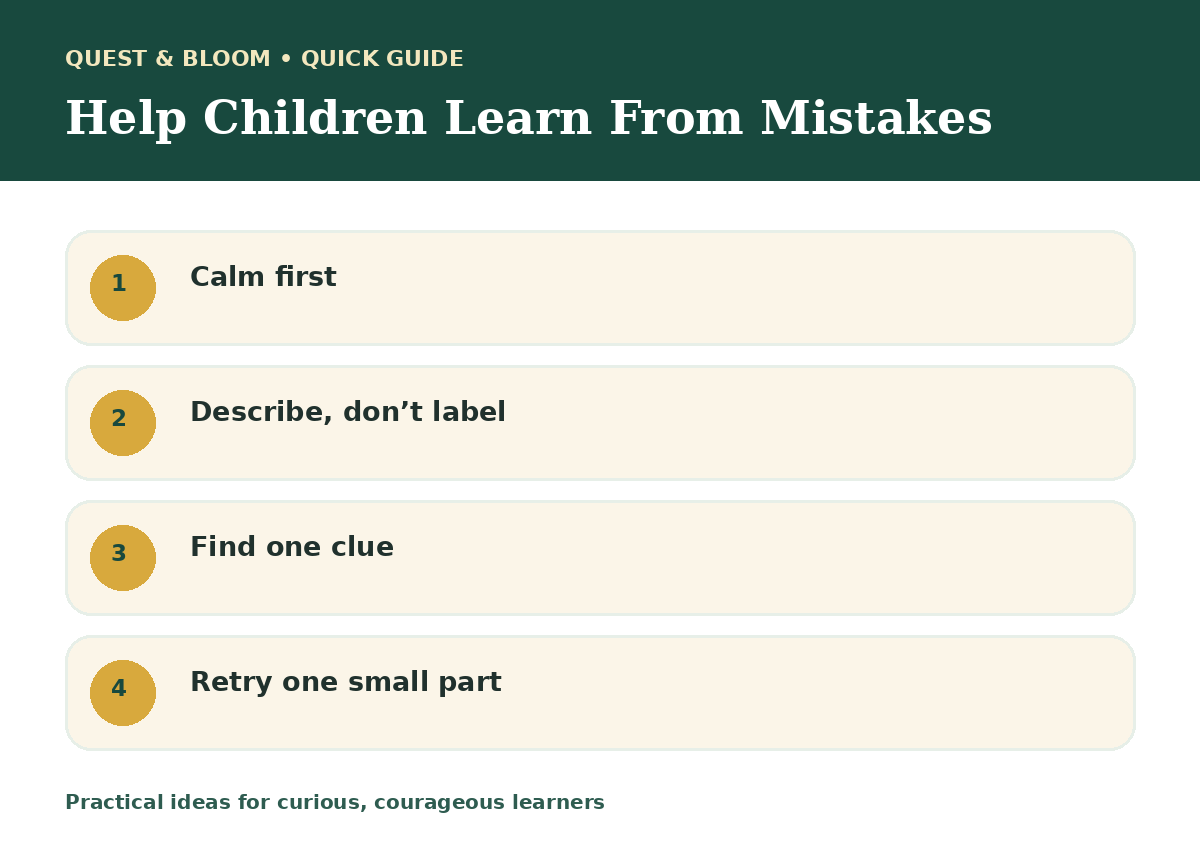
1. Regulate before you investigate
If a child is crying, angry or hiding their work, a rapid-fire review of what went wrong will feel like criticism. Start with the feeling: “You’re really disappointed.”
Give time, water, a cuddle if wanted or a short break. Learning can resume when the child is able to think again.
2. Separate the event from the identity
Replace identity statements with descriptions. “You forgot the full stop” is different from “You’re careless.” “The tower fell when the base moved” is different from “You’re bad at building.”
This keeps the problem specific enough to solve.
- Describe what happened.
- Avoid labels such as lazy, careless or bad.
- Use “this attempt” rather than “you always”.
3. Find one clue
Do not extract ten lessons from one mistake. Ask one or two questions: Where did it start to go wrong? What worked? What will you change?
A child who can identify one clue leaves the experience with something actionable rather than a general sense of failure.
4. Make the next attempt smaller
After failure, confidence is often lower. Reduce the size of the next step so the child can re-enter the task successfully.
For reading, practise the difficult sentence rather than restarting the whole page. For building, repair the base rather than reconstructing everything.
5. Model ordinary mistakes
Let children hear you say “I sent that message to the wrong person,” “I burned that bit,” or “I took the wrong turn.” Then model repair without self-attack.
A calm adult mistake teaches that errors are normal events to respond to, not reasons to feel ashamed.
Related Quest & Bloom guides
- Growth Mindset for Kids: 12 Practical Ways to Help Children Learn, Persist and Grow
- How to Help a Child Who Gives Up Easily: 10 Practical Strategies
- How to Help a Child Deal With Frustration Without Taking Over
- 9 Growth Mindset Mistakes Parents Make — and What to Do Instead
Frequently asked questions
Should I make my child correct every mistake?
Not always. Correct what matters for the learning goal. Too much correction can overwhelm the main lesson.
What if my child lies to hide mistakes?
Respond in a way that makes truth safer. Address the behaviour, but also consider whether fear of punishment or embarrassment is making admission feel risky.
How do I stop perfectionism?
Avoid making every outcome a performance. Model imperfect attempts, praise useful process and create activities where experimentation matters more than a polished result.
Sources and further reading
- American Psychological Association — principles for families and learning
- Stanford — Carol Dweck on process praise, challenge and perseverance
Keep exploring: Our personalised children’s adventures are designed around curiosity, courage, problem-solving and learning through the story itself.
This article is general educational information for parents and carers. Children develop at different rates; seek appropriate professional advice for individual developmental, educational or health concerns.