Resilience is often described as bouncing back, but that can make it sound like children should recover instantly and independently. Young children build resilience inside relationships. They borrow calm, language and problem-solving from trusted adults before they can do those things consistently for themselves.
Everyday family life offers plenty of practice: waiting, losing, trying a new class, sleeping somewhere unfamiliar, arguing with a sibling or discovering that a plan has changed.
If you are building these habits at home, explore our Growth Mindset hub and Quest & Bloom books for more practical ideas.
1. Build a reliable base
Children cope with challenge better when they know support is available. Responsive back-and-forth interaction matters: notice what the child is communicating, respond, and let the exchange continue.
This is not about fixing every problem. It is about being emotionally available enough that the child can explore and recover.
2. Allow manageable difficulty
Resilience cannot grow if every obstacle is removed, but overwhelming children is not helpful either. Look for challenges just beyond easy.
Let the child carry the bag, ask the shop assistant a question, solve the sibling dispute with coaching, or work out how to rebuild the fallen tower.
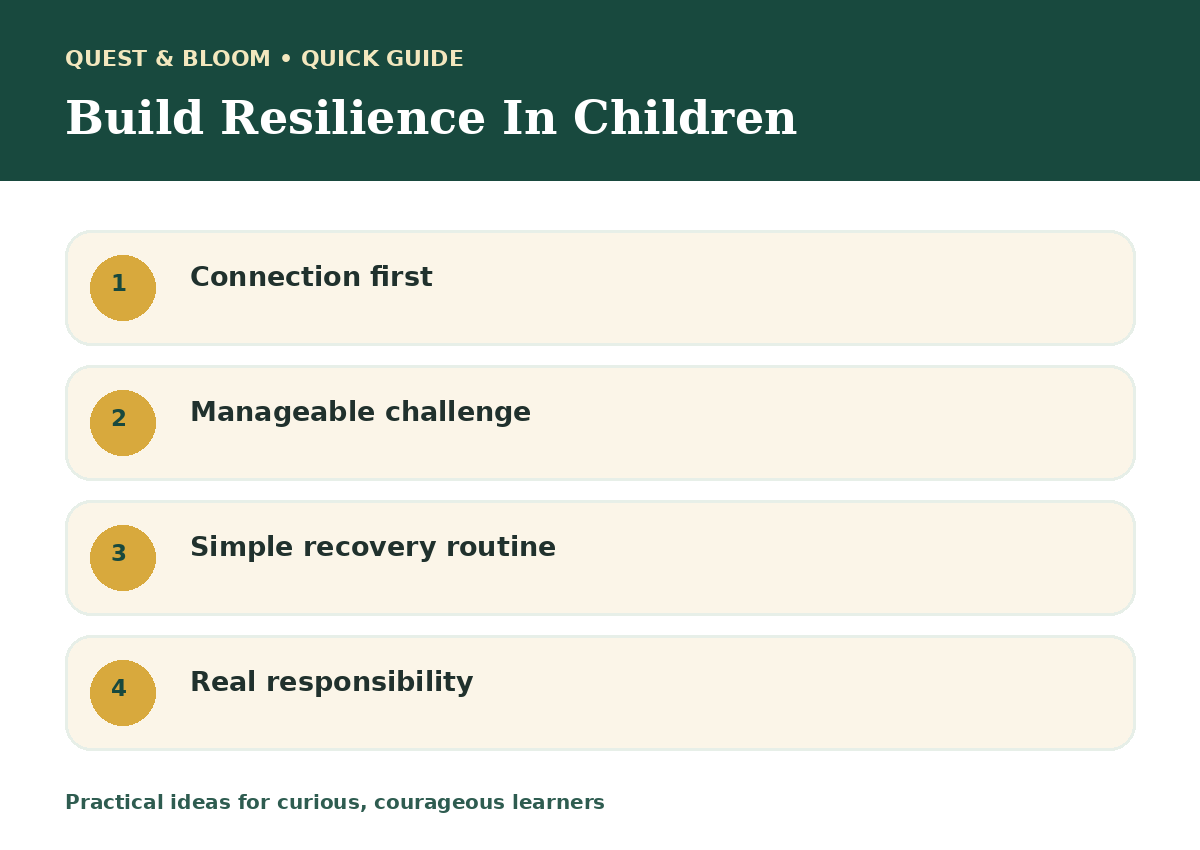
3. Teach recovery routines
When things go wrong, give the child a simple sequence: pause, name the feeling, decide what is needed, choose a next step.
Repeated routines are easier to use under stress than abstract advice such as “be resilient”.
4. Give real responsibilities
Age-appropriate responsibilities build agency. A child who feeds a pet, packs part of their bag or helps prepare food sees themselves as someone who can contribute.
Keep responsibilities achievable and teach the task before expecting independence.
5. Let play do some of the work
Play naturally involves negotiation, rules, imagination, risk assessment and adapting plans. The American Academy of Pediatrics has highlighted developmentally appropriate play as important for cognitive, social-emotional and self-regulation skills.
Unstructured or lightly guided play gives children opportunities to solve problems without an adult scripting every move.
Related Quest & Bloom guides
- How to Help a Child Who Gives Up Easily: 10 Practical Strategies
- How to Help a Child Deal With Frustration Without Taking Over
- 15 Confidence-Building Activities for Kids Ages 4–8
- Growth Mindset at Home: A Simple Daily Routine for Busy Parents
Frequently asked questions
Does resilience mean children should not cry?
No. Emotional expression and resilience can coexist. The important skill is being able to recover and find support or a next step.
Can I make my child more resilient by being stricter?
Resilience is not produced simply by more hardship. Supportive relationships plus manageable challenge are more useful than deliberately making life harsher.
What if my child avoids new situations?
Use gradual exposure: make the first step small, predictable and supported, then build from successful experiences.
Sources and further reading
- American Psychological Association — principles for families and learning
- Stanford — Carol Dweck on process praise, challenge and perseverance
- American Academy of Pediatrics — The Power of Play
- Harvard Center on the Developing Child — Serve and Return
Keep exploring: Our personalised children’s adventures are designed around curiosity, courage, problem-solving and learning through the story itself.
This article is general educational information for parents and carers. Children develop at different rates; seek appropriate professional advice for individual developmental, educational or health concerns.